

For those considering roles within technology companies without coding knowledge or experience, this is possible if you do decide to become a product manager. Let’s face it, everyone wants to work in tech. Think about it, you can work remotely, the company-branded swag bags are always top-notch, and the pay is divine. However, some people have the notion that you have to possess coding skills to work in a technology company. While proficiency in Scala, Kotlin and Ruby programming languages may help you snag the top-paying jobs in the tech space, those nerds or in Nigerian parlance “tech bros” need someone to help them understand the vision.
Who is a Product Manager?
In simple terms, a product manager is somewhat like a business analyst (you can read up on the business analysis role here). They are tasked with first understanding the needs of users. This means they carry out quite a lot of research. The research they carry out include but are not limited to market research, user testing, focus group studies etc. This activity helps them identify the gaps in their products and also helps them decide on the best product direction. This brings us to our next point.
The product manager is a visionary. They focus their energies on “what might be” rather than “what is”. They are not restricted to information about the current status quo but often focus on the bigger picture. So if you say they are the definition of “out-of-the-box” thinkers, you would absolutely be right. This skill is essential when working in radically innovative companies such as Apple and Google.
To summarize this section, we can say that the product manager is the person primarily responsible for establishing the product or product line strategy, developing the roadmap, and defining the features of the product.
Overview of the Job Market for Product Managers
This is a role that is always in demand as the advancement in technology drives the launch of new software and hardware products every day.
Product management has slowly but consistently included more external contact with customers in recent times. It is gradually moving away from its internal or technological focus to include more business-related activities.
Product teams can create better products that benefit a wider audience by gaining a deeper understanding of what users actually need. Therefore project managers will always be needed.
According to Burning Glass, the current wait time to fill a product manager post is 36 days. This shows that businesses are spending a lot of time looking for quality individuals who are available
Product Manager Salary and Opportunities
According to Glassdoor, product managers make an average of $85,235 annually as base pay in the United States. Not too shabby right? Comparbly actually pegs the average base pay for the Global Product Manager at $94,464.
Unfortunately, there is still some disparity gender-wise when it comes to remuneration as outlined in the image below.

Source: Zippia
According to the quick Linkedin search that was carried out, at the time of this post, there were 63,764 within the past seven days for product manager jobs in the United States and 548 results for opportunities in Sub-Saharan Africa. Filtering the US results to identify entry-level positions, 8,726 opportunities were identified.
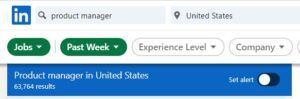

Filtering down further using the same set of parameters, 1,986 results were open to those interested in a part-time position while 104 positions were available to those seeking internship positions.
In Sub-Saharan Africa, they were mostly full-time positions and only one internship position was found.
To get in, you might want to take a look at organizations where age is not considered a factor in securing internship positions.
Responsibilities of a Product Manager
- Product requirements definition
- Research – This includes user research, market and competitor research.
- Identifying and measuring key metrics
- Development and maintenance of the product road map.
- Collaborating with the core technical team
- Engagement with clients and customers
- Coaching and recruitment
Product Manager Skills Requirements
These will be grouped into soft skills and hard skills. Also, note that the exact combination of skillsets will defer from company to company.
Product Manager Soft Skills
- The ability to empathize – This helps you understand the underlying challenges faced by your users
- Communication
- Presentation skills
Product Manager Hard Skills
- Research and Analysis – The ability to conduct market research and carry out basic analysis is certainly a must-have.
- Basic entrepreneurial or business skills – This includes an understanding of your customer acquisition costs, understanding cash flow statements, customer lifetime value, budgeting, user churn rates and other key metrics.
- Knowledge of user experience design
- Excellent documentation skills – This helps with product improvement and aids in traceability when there are issues spotted.
- Prioritization is key – Your ability to use productivity tools like Trello and Slack for managing your workflow is also crucial.
In subsequent posts, we would bring you a summary of courses and training you can take to get you well on your way to becoming a product manager.
What do you think about this post? Do let us know by leaving some feedback in the comment section below.






Trackbacks/Pingbacks