

In today’s episode of Frankly Dukky, we will be discussing the shutdown of Kenyan food tech company Kune and the startup lessons learned.
According to founder Robin Reechthad, the company sold over 55,000 meals and had a database of over 100 corporate customers and 6,000 individual customers. The company’s business model revolved around selling $3 meals to its clientele through its in-house apps, canteens and vending machines.
The news of its closure came through the founder’s LinkedIn page where he cited price sustainability, “current economic downturn” and “investment markets tightening up” as reasons for the closure. Let me just say this, having no inside knowledge as to the reasons why the business actually shut down, like many other areaders who have been following the news, I can only speculate. However, we will be looking at some facts and figures that are readily available on the internet to try to understand how a business that had just received $1 million in pre-seed investments shut down exactly 12 months later and what startup lessons there are to learn.
Let’s start with the reactions…
Some people are of the opinion that they had to close shop because they ran out of money from overpaying themselves.
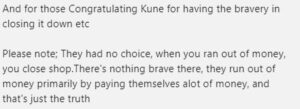
Others feel there is more to this than meets the eye and the founder should be asked some hard questions.

Now we will attempt to understand how this could have happened and what startup lessons we can take away from it.
Startup Lessons from Kune Africa
-
Founder’s Background
Mr Reechthad graduated with a Bachelor’s degree in Business Administration from École des sciences de la gestion (ESG UQAM) in Montreal, Canada. He spent a year in business development at DocuSign. He went on to establish Hanoia, a company that creates co-living housing for the Vietnamese populace. According to the information on Crunchbase, it shut down 2 years, 9 months later in November 2019. He then proceeded to work with Ayomi.fr as an investment manager where he spent 5 months with them before founding Kune in December of 2020.
My thoughts- Academic background check, network check. I believe his brief stint as an investment manager at Ayomi either opened some doors or helped him establish the much-needed network to raise funds for Kune. Think about it, how many African startups have been able to secure $ 1 million pre-seed, after their launch, let alone prior to it. It is certainly worth studying.
My second takeaway is that having a degree in business and knowing all the right people does not guarantee success. So dear sisters, please take it easy on yourselves.
2. Product Pricing
Kune offered meals for $3. I decided to look up the cost of an average meal in Kenya and according to Numbeo, the average cost of a meal at an inexpensive restaurant in Kenya goes for 450.00 KSh. According to Oanda converter, that is $3.7. This tells me they were targeting the low to middle-income bracket. If you remember, the unsustainability of the prices was one of the reasons cited for business closure.
While I understand that the cost of agricultural inputs in Africa has tripped in the past year, which would have a negative impact on food prices in the market, I wonder if this could not be addressed differently. This comes from the fact that the Kune operates an end-to-end model. You see, they prepared their meals in-house at a factory that was built for that purpose and they also handled delivery to retail and corporate customers in-house.
My thoughts: Could a 1 – 2 dollar price increase have saved the day? A couple of restaurants increased food prices this year by at least 25% and they still seem to be in business. Could they have benefited from outsourcing meal preparation to a partner company so they could focus on the key aspects of the business that were not capital intensive in the meantime? Building a factory is a capital-intensive activity. Investing in such a project so early in the game seems quite risky to me. The startup lesson here is simple. Start small, iterate fast.

Image credit: Kune Africa
3. Building the Team
Data on Linkedin shows that they have 48 employees. Let’s not forget they had $1 million that was to be spent on building a factory, sourcing produce, marketing and procurement of whatever means of transportation they had in mind for the deliveries.
My thoughts: Hiring 48 persons in the span of one year for a business that is not earning enough of its keep is a tad too much. Hiring too fast can kill your business faster than you think. Think about the core activities that need to be carried out and hire staff to carry out those core activities. There has to be enough consideration given to the purpose for which you are hiring, the suitability of the candidate for that role and how soon you expect to get results from the potential employee.
4. Finance and Operations
Midway through the burn, was the founder alerted of the company’s burn rate? It would be nice to know if this happened and what strategies the operations manager or finance manager came up with. I would like to think he would have seen the red flags at least 5-6 months to the end of the runway.
My thoughts: Every business situation is unique but there is a common denominator that binds every business- money. You need money to run a business and so you should always keep an eye on your spending rate. Forecasting expenses every six months ( to account for inflation) will help give you an idea of how much runway you have. It feels good to raise funds, but the trick to ensuring that money lasts as long as possible is to spend it like you never had it.
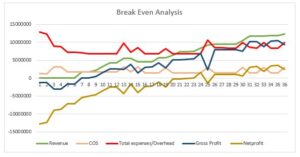
Keep your eye on your monthly sales figures, what percentage of your monthly business expense is that? Every month, both lines on the chart should be getting closer and closer to each other until your income exceeds your expense. If this trend is not visible in your financials, then you have a problem.
In Summary
As cliche as this sounds, it is okay to fail. It is the lessons that we learn from our failures that make us stronger. An education, networks with the right individuals and a ton of money in financing does not shield you from failure. Take your time to understand the market and the terrain. Run many experiments as fast as possible and iterate quickly before you go into the waters with both feet.